
A custom POS stand can look complete at the sample stage and still create problems in daily use. A terminal may fit the cradle but leave too little space for a connector. A hinge may feel smooth during a short demonstration but loosen after repeated operation. A finish may match the approved color while its thickness varies across a production batch.
The purpose of pre-production validation is to find those gaps before volume manufacturing begins. It connects the device, installation environment, mechanical design, finish, assembly method, and packaging in one practical review.
A useful validation plan does not apply every available test to every product. It selects the checks, sample size, method, and acceptance criteria that match the design and its target market.
Start With the Actual Device and Installation
The first check is not a laboratory test. It is a complete fit review using the actual payment terminal, tablet, display, or approved dimensional data.
Important questions include:
- Does the device locate positively without unwanted movement?
- Can staff reach the screen, keypad, camera, scanner, and contactless area?
- Do power and data connectors have enough clearance?
- Is the cable bend radius practical throughout the full tilt or rotation range?
- Can the device be removed for servicing without dismantling the installation?
- Does the base, pole, wall plate, or vehicle interface match the real mounting surface?
These points should be reviewed as one system. A small change to the cradle can affect the cable path; a different fastener can change service access; and a larger rotation range can alter stability.
Convert the Use Case Into Acceptance Criteria
“Strong,” “stable,” and “durable” are useful goals, but they are not inspection criteria. Before a pilot run, the buyer and manufacturer should turn the use case into points that can be checked consistently.
| Area | Question to define | Example check |
|---|---|---|
| Device interface | Which terminal model or dimensional revision applies? | Fit, clearance, retention, and removal |
| Movement | How often will users tilt or rotate the device? | Range, smoothness, play, and stop position |
| Installation | Counter, pole, wall, vehicle, or kiosk? | Hole pattern, fasteners, stability, and access |
| Finish | What appearance and service environment are expected? | Color, texture, coverage, and coating thickness |
| Packing | How will the order be shipped and handled? | Part protection, carton layout, labels, and pack-out |
This definition is especially important for OEM and ODM work. Two stands with a similar silhouette may require different verification because one is used on a supervised checkout counter and the other inside an unattended kiosk.
Once the acceptance criteria are clear, the pilot should also represent the intended production route. Datum choices, fixture access, tool access, and inspection points need to support repeatable manufacturing—not only a successful one-off sample.
Review Repeated Movement and Cable Behavior
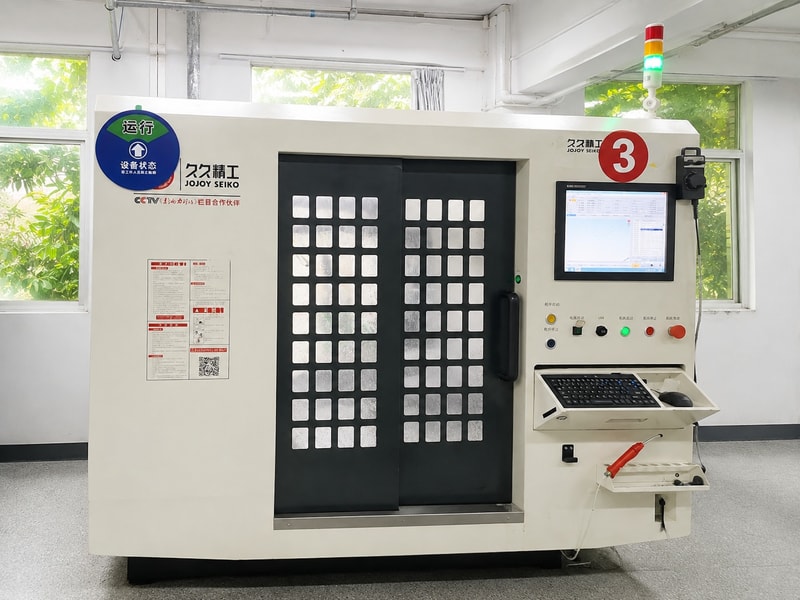
Moving parts deserve more than a single hand check. During a project review, the team should confirm the intended angle, rotation range, operating force, end stops, fastener retention, and acceptable play after repeated use.
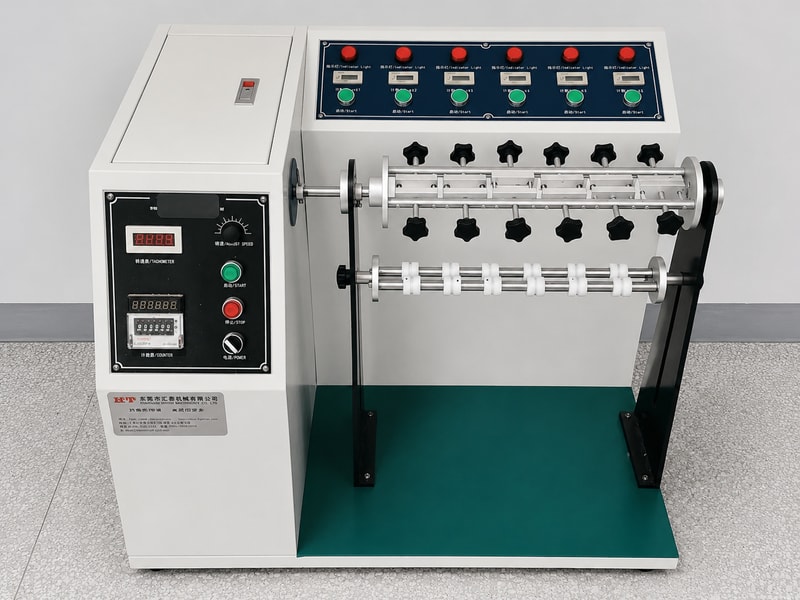
The cable route should be reviewed at the same time. A stand can pass a mechanical movement check while repeatedly rubbing, twisting, or pinching the terminal cable. Where a project includes flexible cable assemblies or other repeated-motion components, a defined cycle test can help reveal fatigue or routing problems before production is locked.
After testing, inspection should cover more than whether the part still moves. Look for changes in operating force, loosened fasteners, surface contact marks, cable damage, deformation, noise, and excess play.
Measure the Finish Instead of Judging It Only by Eye
Color and texture matter because POS hardware sits in a customer-facing environment. Visual approval is necessary, but visual inspection alone does not show whether a coating is consistent.
A finish plan can define the approved color or master sample, gloss or texture expectation, acceptable cosmetic zones, coverage at edges and holes, and a suitable thickness range for the selected material and coating process. Measuring representative points creates a record that can be compared across pilot and production batches.
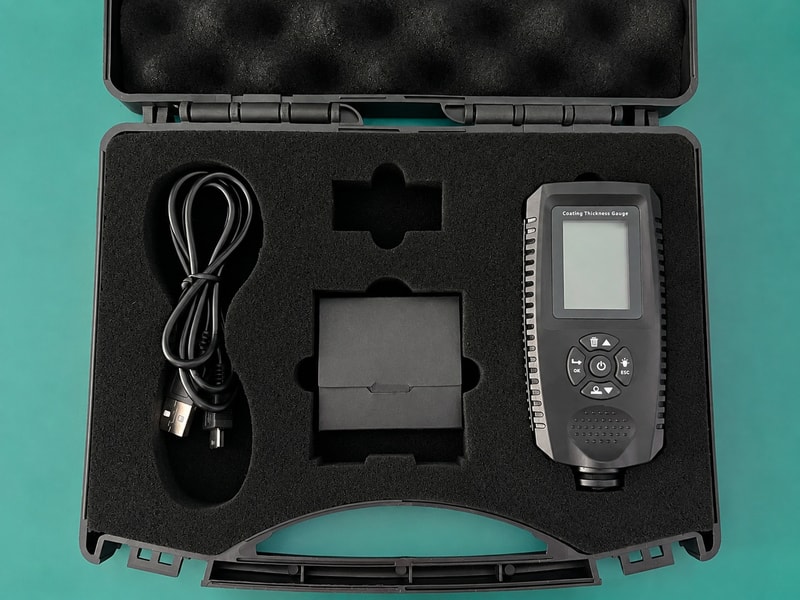
Measurement locations should be agreed in advance. Flat surfaces, edges, recessed features, and welded areas may not behave in the same way during finishing, so a single reading is rarely enough to describe the whole part.
Match Corrosion Checks to the Service Environment
The corrosion risk for a dry indoor checkout is different from the risk in food service, transport, coastal locations, or areas cleaned frequently with chemicals. Material choice, pretreatment, coating system, exposed edges, and fastener selection should therefore be reviewed against the real installation environment.
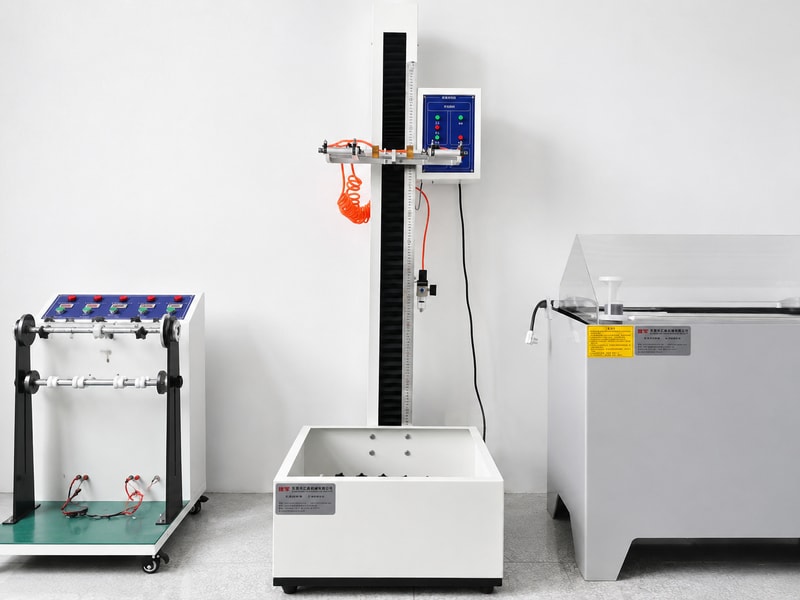
Salt-spray equipment can support comparative or specification-based corrosion evaluation when it is appropriate to the project. The agreed plan should state the preparation, duration, sample condition, inspection method, and pass criteria. A test duration without a defined acceptance condition does not give the buyer a useful result.
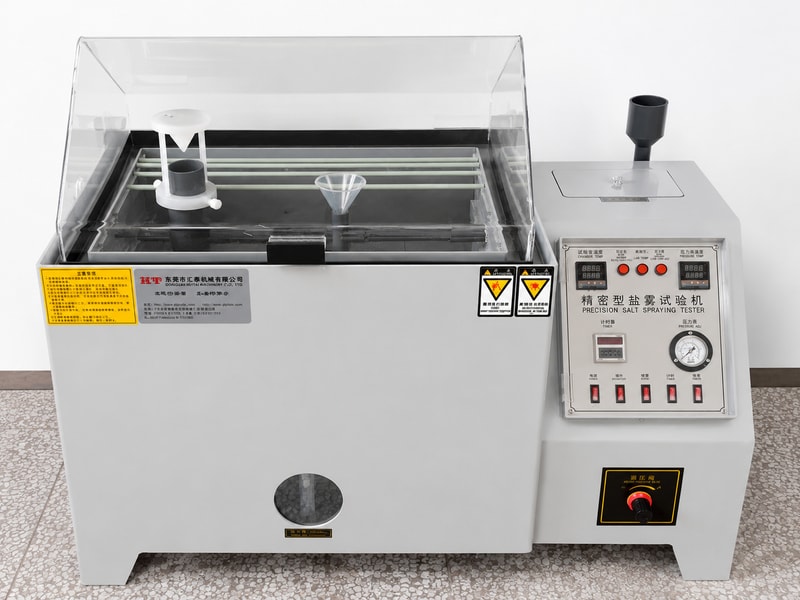
It is also important to inspect the design itself. Water traps, unprotected cut edges, mixed metals, and damaged coating around fasteners can create local risks even when the main surface finish is acceptable.
Verify Material and Critical Hardware
Material verification is broader than checking a name on a drawing. The production review may include supplier documentation, dimensions, wall thickness, hardness where relevant, fastener grade, thread engagement, tightening method, and the condition of machined or formed features.
Portable hardness equipment can be useful for suitable metal parts, but hardness is only one property. It should be treated as one part of the agreed material and process controls rather than proof of complete product performance.
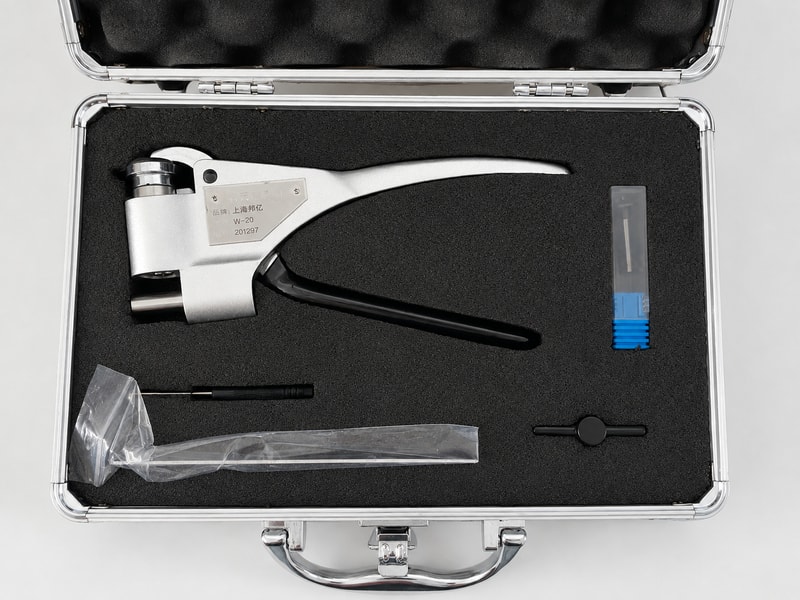
Critical hardware should be easy to identify on the inspection plan. Pivot screws, locking fasteners, base fixings, device-retention parts, and cable-protection components often deserve more attention than non-functional cosmetic hardware.
Approve the Complete Pack-Out, Not Only the Stand
The final product received by the installer includes more than the metal assembly. It may include adaptor plates, fasteners, adhesive pads, cable clips, keys, tools, instructions, labels, and market-specific accessories.
A pilot pack-out review should confirm:
- Every component has a defined quantity and location.
- Finished surfaces cannot rub against one another in transit.
- Small hardware is identified and retained.
- The carton protects the heaviest and most exposed areas.
- Labels, manuals, and model references match the shipped configuration.
- The packed unit can be unpacked and installed in a logical sequence.

Where transit simulation or drop checks are required, the method should reflect the actual carton, packed weight, shipping route, and customer requirement. Testing an unpacked sample does not answer the same question as validating the complete shipping pack.
A Practical Pilot-Approval Checklist
Before approving volume production, confirm that the project record includes:
- The final device model, drawings, and installation interface.
- An approved physical sample or clearly controlled reference unit.
- Critical dimensions and their inspection method.
- Movement, stability, fastening, and cable-routing criteria.
- Material and finish requirements, including approved appearance samples.
- Project-specific durability, corrosion, or environmental checks.
- Assembly instructions and critical process controls.
- Packaging layout, accessories, labels, and shipping configuration.
- Agreed sampling levels and a process for handling nonconforming parts.
- Written approval of any changes made after the pilot build.
The strongest quality plan is not the one with the longest test list. It is the one that connects the real terminal and installation environment to clear, repeatable decisions before mass production starts.
Planning a device-specific mounting project? Send Haiyuan your terminal model, installation details, quantity, and finish requirements to begin a practical engineering review.